Lightning Packs — lightening your load, lighting your way

Suspended-load energy harvesting

Introducing the first electricity generating backpack

Lightning Packs invented and manufactured the first electricity-generating rucksack for our military, disaster relief workers, and hikers. Not only do our rucksacks generate electricity, but they reduce the dynamic loads on the user's back and joints.

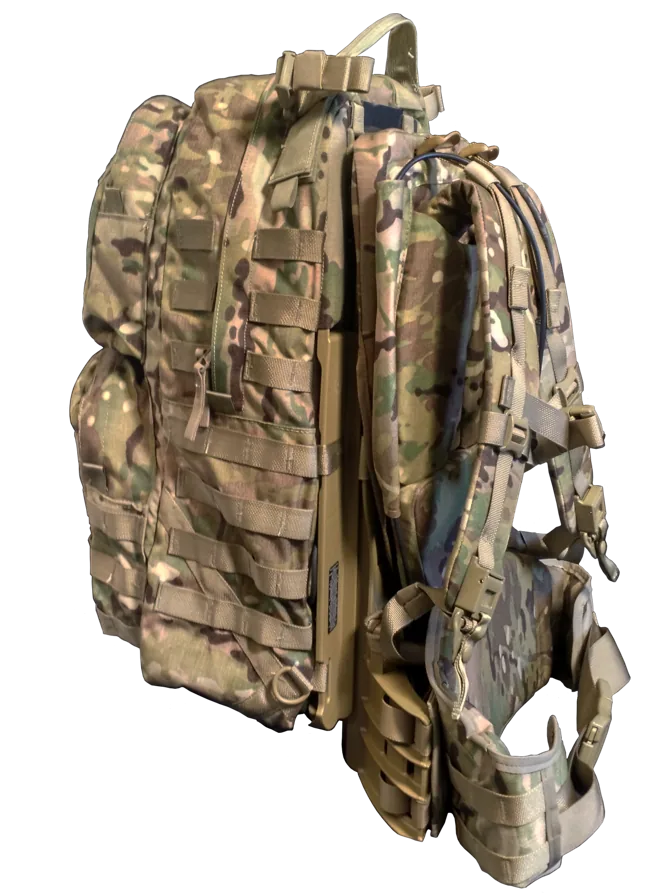
Lightning Packs MOLLE rucksack in MultiCam, shown from the side with the suspended-load frame and harness visible.
  • 7–35 WGenerated while walking
  • 82%Less accelerative force, walking
  • 90%Less accelerative force, running
  • 8–12 lbExtra load carried for free

Two problems, one frame

The pack's load moves relative to the wearer. That relative movement drives a generator — and, at the same time, decouples the load from the body's vertical motion.

Electricity generating design

Wearable renewable electricity for soldiers on the move

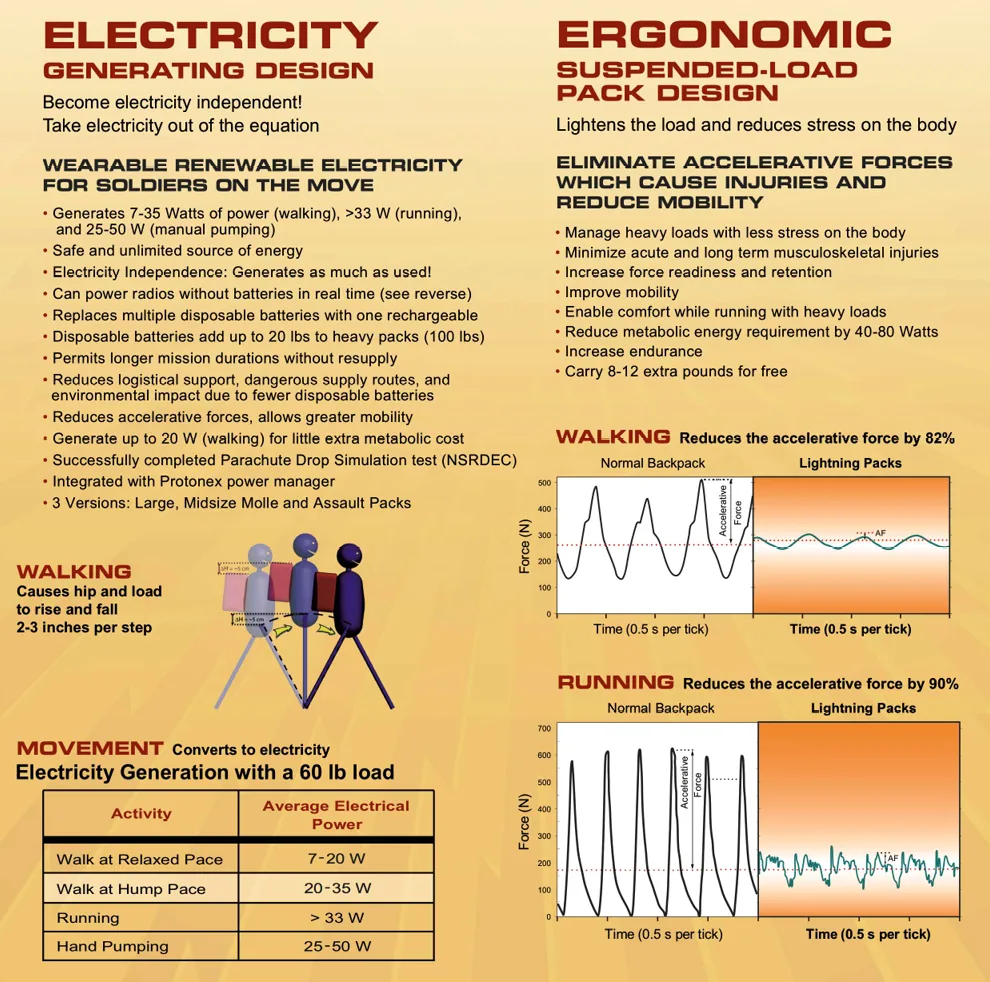
  • Generates 7–35 Watts of power (walking), >33 W (running), and 25–50 W (manual pumping)
  • Safe and unlimited source of energy
  • Electricity independence: generates as much as used
  • Can power radios without batteries in real time
  • Replaces multiple disposable batteries with one rechargeable
  • Disposable batteries add up to 20 lbs to heavy packs (100 lbs)
  • Permits longer mission durations without resupply
  • Reduces logistical support, dangerous supply routes, and environmental impact due to fewer disposable batteries
  • Reduces accelerative forces, allows greater mobility
  • Generate up to 20 W (walking) for little extra metabolic cost
  • Successfully completed Parachute Drop Simulation test (NSRDEC)
  • Integrated with Protonex power manager
  • Three versions: Large, Midsize MOLLE, and Assault packs

Ergonomic suspended-load design

Eliminate accelerative forces which cause injuries and reduce mobility

  • Manage heavy loads with less stress on the body
  • Minimize acute and long-term musculoskeletal injuries
  • Increase force readiness and retention
  • Improve mobility
  • Enable comfort while running with heavy loads
  • Reduce metabolic energy requirement by 40–80 Watts
  • Increase endurance
  • Carry 8–12 extra pounds for free

Walking causes the hip and load to rise and fall 2–3 inches per step. The suspended-load frame absorbs that movement instead of transmitting it into the spine.

What the load actually does to you

Force measured at the shoulder straps over time, carrying the same load. A rigid pack spikes with every step. The suspended-load frame flattens the curve.

Walking Accelerative force −82%

500 N 265 N 0 N TIME (0.5 s per tick)
Normal backpack Lightning Pack
Hip and load rise and fall 2–3 inches per step. The frame takes that travel instead of the wearer.

Running Accelerative force −90%

700 N 168 N 0 N TIME (0.5 s per tick)
Normal backpack Lightning Pack
Running is where rigid packs punish the spine hardest, and where the suspended-load frame gains the most.

Electricity generation with a 60 lb load

Movement converts to electricity. Output scales with pace.

Average electrical power by activity
ActivityAverage electrical power
Walk at relaxed pace7–20 W
Walk at hump pace20–35 W
Running> 33 W
Hand pumping25–50 W

Configurations

Three versions: Large, Midsize MOLLE, and Assault packs. Integrated with the Protonex power manager. Successfully completed Parachute Drop Simulation test (NSRDEC).

Metabolic cost

Generate up to 20 W while walking for little extra metabolic cost, and reduce metabolic energy requirement by 40–80 Watts through suspended-load carriage.


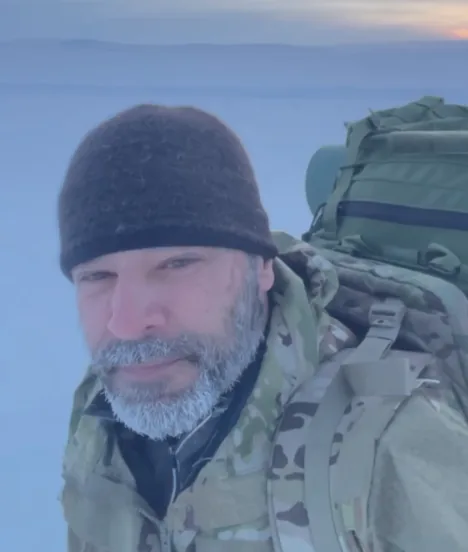
The Lightning Pack has been tested in some of the toughest places on Earth with some of the toughest people on Earth.

A bearded tester in MultiCam with frost in his beard, carrying a Lightning Pack across snow at dusk in the Arctic Circle.
Testing the Lightning Packs in the Arctic Circle in Resolute Canada
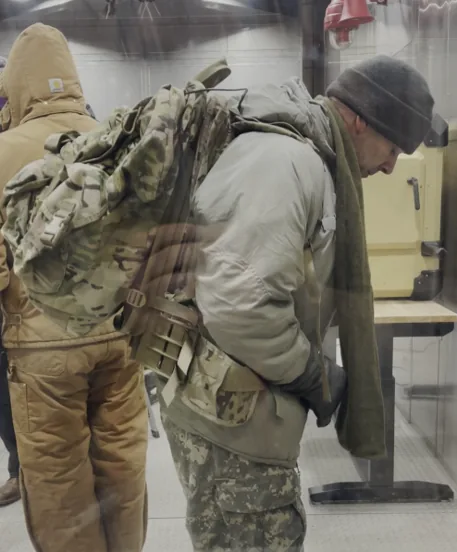
A tester in cold-weather gear shouldering a Lightning Pack inside a cold chamber at the US Army CRREL facility.
Testing the Lightning Pack at the US Army's Cold Regions Research and Engineering lab (CRREL)
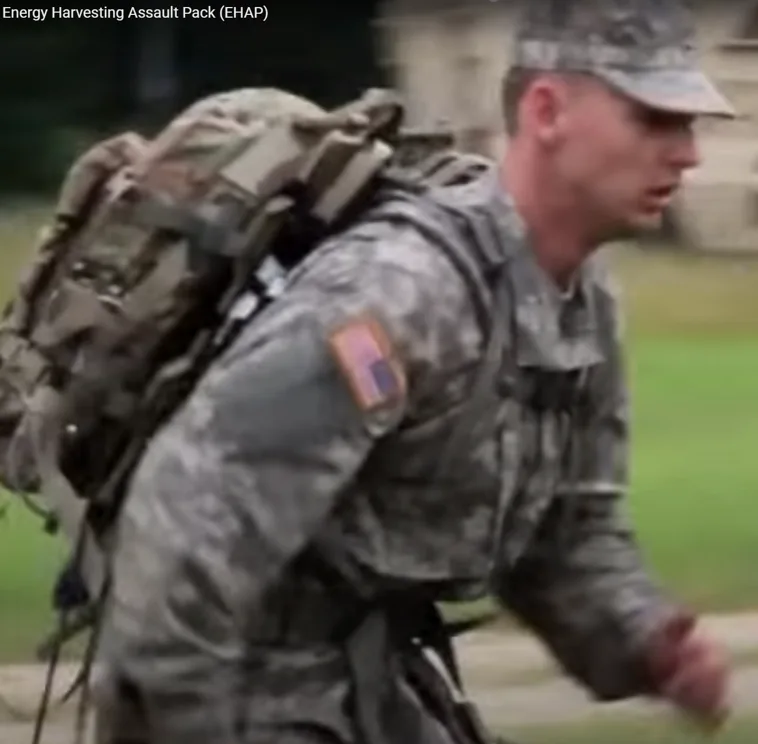
A soldier in ACU running with an Energy Harvesting Assault Pack at Aberdeen Proving Grounds.
Testing the Lightning Pack at the US Army's Aberdeen Proving Grounds

Team

Dr. Lawrence Rome

Founder and Chief Scientific Officer

Larry received his A.B. from Dartmouth College and PhD in Biology from Harvard University. He did his postdocs in the UK and Harvard Medical School, took his first faculty position at the University of Tennessee (Knoxville) and then moved to the University of Pennsylvania in 1989 where he is a Professor of Biology. Throughout this period Rome has also been a Whitman Investigator at the Marine Biological Lab in Woods Hole, MA. Rome's focus is muscle mechanics and energetics, and he specializes in fish muscle, locomotion and sound production.

Sean McIntosh

Director of Engineering

Sean received his bachelor's and master's degree in Mechanical Engineering from the University of Delaware. He specializes in Mechanical Design and Manufacturing.

Shawn Carmody

Product Development Manager

Shawn attended UNC Charlotte and American Military University. He is a former Marine Staff Sgt with nine years of experience in Force Recon in both 2nd and 5th Force Reconnaissance Company.

Steve Lebischak

Chief Business Strategist

Steve is a consultant that specializes in helping consumer good technology companies turn R&D into commercialized profit. As the CEO of Asius Technologies, LLC, he helped the company win more than $1M in research grants from the National Science Foundation and the National Institute of Health and provide the overall strategy of the company regarding product development, licensing and 2013 product launch. He was instrumental in the company's selection and success as one of the Wall Street Journal's "Top 24 Startups of 2013."

Contact

Procurement, licensing, and evaluation-unit inquiries.

Address
401 School House Lane
Wayne, PA 19087
Phone
610-995-2728
Engineering
shmcintosh@gmail.com
Founder
lawrence.rome@gmail.com